
Integration between Ongoing WMS and Inretrn
The Inretrn post-purchase engine integrates closely with your warehouse processes to improve operational efficiency while capturing business-critical data related to products, returns handling, and refund processes. The platform is designed to automate and digitalize the post-purchase flow to the highest possible degree including a wide range of exception scenarios typically occurring in returns and claims receiving processes.
Together with Ongoing WMS, Inretrn can help you gain full control of all return processes in your warehouses.
Integration features
Inretrn offers two integration models when working with Ongoing WMS. Both options can be implemented by merchants running Ongoing in their own warehouse operations as well as by 3PL providers managing multiple goods owners.
Inretrn Warehouse module
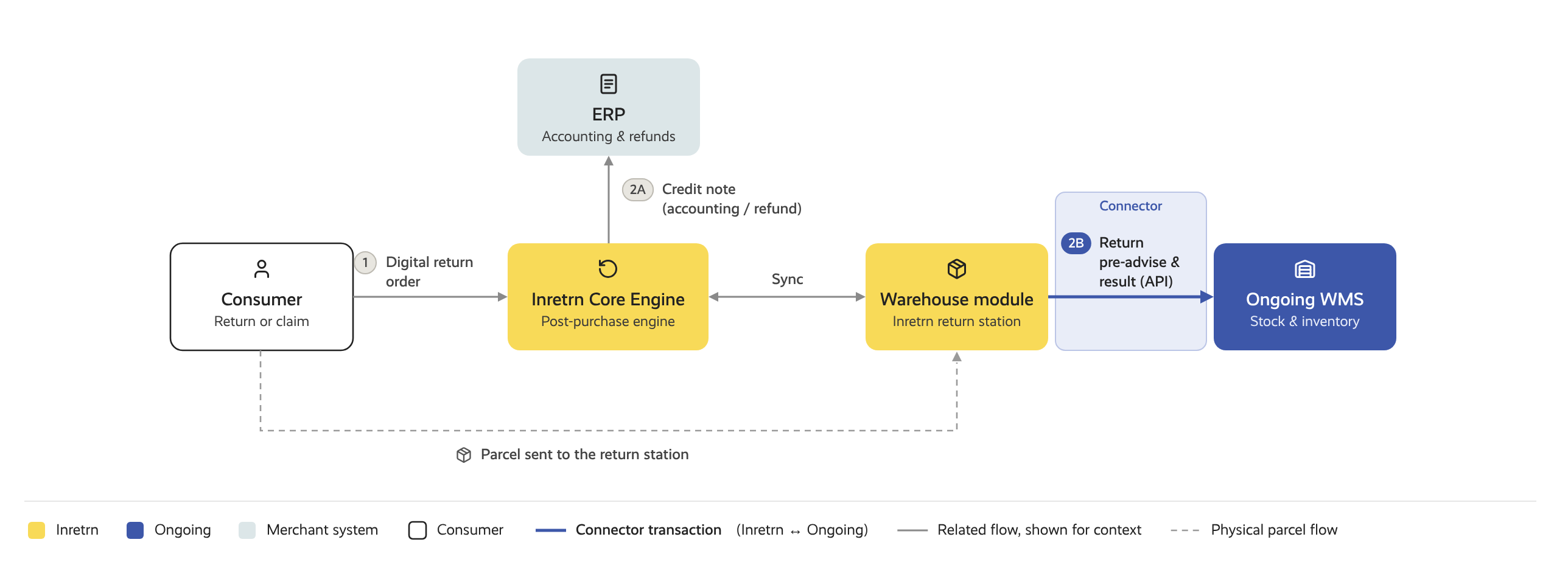
This option is designed for merchants with high return volumes or where business requirements demand a more advanced way of receiving and handling returns than what is typically handled directly in a WMS. The solution supports both standard (“happy flow”) returns and a high share of exception scenarios in a cost-efficient and quality-controlled way.
Before the physical receiving process begins, Ongoing can be pre-advised with a preliminary return order based on the end customer’s digital return registration. This step is optional but can be used to support inbound forecasting, planning, and staffing using Ongoing’s native capabilities.
This setup enables full functionality within the Inretrn Warehouse module, allowing post-purchase processes to be handled outside the WMS while maintaining synchronization. Key capabilities include:
- Priority scanning
- Product condition-based charging
- Customer service ticket escalation
- Product category-specific step-by-step quality control
- Use-case-specific end-customer communication
- Photo documentation, comments, and data insight collection
- Automatic sorting logic
- Exchange release handling
When the return order is fully processed and matched against the original sales order, a handshake transaction is executed between Inretrn and Ongoing. Inretrn uses the Ongoing Goods Owner Returns REST API to synchronize the return transaction. Stock is then automatically increased at a predefined location in Ongoing, allowing the next warehouse process step to be executed.
The return transaction is automatically closed, triggering downstream transactions across connected systems to complete the refund process according to the configured return policy, while also initiating end-customer communication.
API reference
| Step | Call | Description | API documentation |
|---|---|---|---|
| 2B | PUT returnOrders |
Creates the return order (return pre-advise) in Ongoing when the consumer registers a digital return. Normally one call per return, more if the return is split. | Goods owner REST API – PUT /api/v1/returnOrders |
| 2B | POST goodsOwnerReturns/return |
Reports the outcome to Ongoing when the return is approved in the Warehouse module (quantity, return cause, stock location, user). One call per return line. | Goods Owner Returns REST API – POST goodsOwnerReturns/return |
Return receiving process managed directly in Ongoing WMS
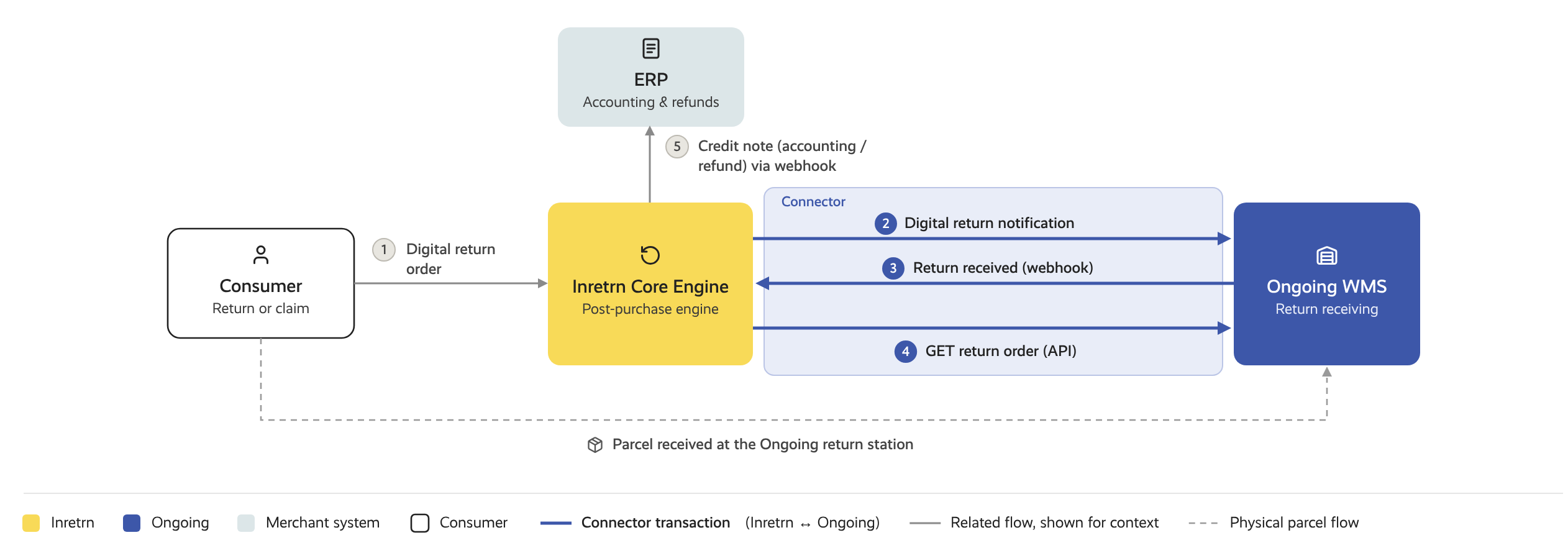
In this setup, Ongoing is pre-advised with a preliminary return order based on the end customer’s digital return registration prior to physical receiving.
Warehouse operators work entirely within the standard Ongoing WMS return receiving workflows. Once the return is completed in Ongoing, Inretrn is notified via webhook. Inretrn then retrieves the completed return order, verifies the data, closes the return transaction, and automatically triggers all downstream processes required to complete the refund transaction according to the return policy, including end-customer communication.
API reference
| Step | Call | Description | API documentation |
|---|---|---|---|
| 2 | PUT returnOrders |
Creates the return order (return pre-advise) in Ongoing when the consumer registers a digital return – same call as in the Warehouse module setup. Only used for pre-registered returns; without a digital registration nothing is written to Ongoing. | Goods owner REST API – PUT /api/v1/returnOrders |
| 3 | POST /v2/webhooks/ongoing |
Ongoing (or middleware) calls the Inretrn External API when the return has been handled in the warehouse. Authenticated with the X-Auth-Token header. | |
| 4 | GET orders?goodsOwnerId={id}&orderNumber={orderNumber} |
Inretrn reads the order from Ongoing to close or create the return in Inretrn. | Goods owner REST API – GET /api/v1/orders |
This option is well suited for merchants where the existing Ongoing return receiving process meets operational requirements. It supports standard return flows and a limited set of exception scenarios, such as uncollected shipments. It can also be a strong fit for 3PL environments where a standardized process across multiple goods owners is preferred.
Getting started
Inretrn has built and maintains the integration with Ongoing WMS. To set up the integration with Inretrn, please reach out to them directly.
Prior to 2023 Inretrn was known as Easycom.